

Choosing wind resistant trees for a Portland-area yard starts with shape and structure, not a species name. Colorado State University Extension, quoted on a University of Washington horticulture library answer about wind-tolerant plants, puts it this way: “Wind-resistant trees usually have flexible, wide spreading, strong branches and low centers of gravity.”
That one sentence gives you a way to judge any tree before you buy it, and it explains why some popular yard trees snap in a gust while others just sway.
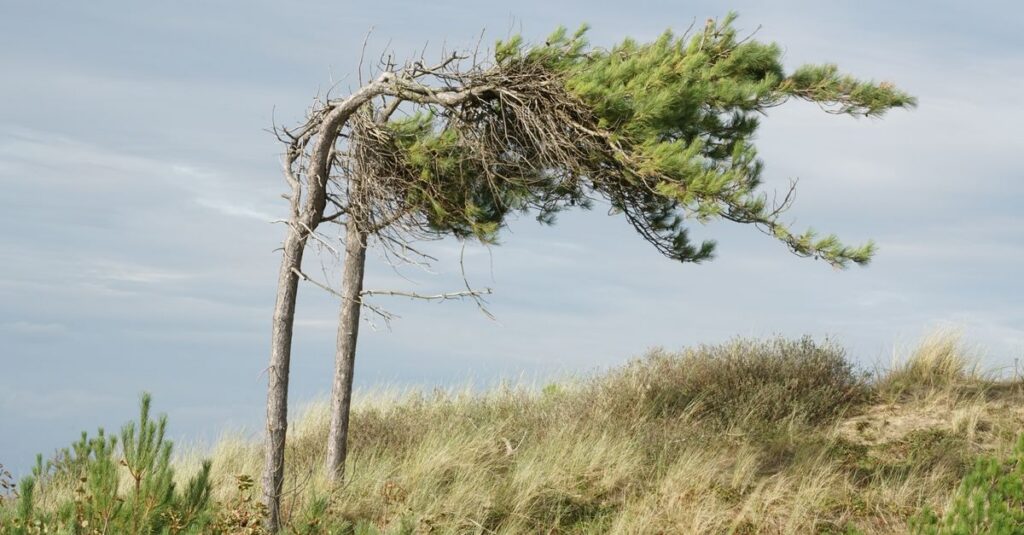
Cover photo by Marian Florinel Condruz on Pexels
What makes wind resistant trees different
Four traits do most of the work, based on the Colorado State guidance quoted above. A tree doesn’t need all four, but the more it has, the better it will cope with a hard blow.
- Flexible wood and branches that bend with a gust instead of cracking.
- Strong, wide-spreading branches attached firmly to the trunk.
- A low center of gravity, so the weight of the crown sits closer to the ground.
- Leaves, stems or needles that don’t act like a sail. The same source says plants with large, flat leaves “catch” wind and tend to lose branches in strong gusts or under heavy, wet snow.
If you’re looking at two trees of similar size, the one with smaller leaves and a sturdier branching pattern will cope better in an exposed spot.
Why conifers are the first wind resistant trees to consider
Evergreen conifers earn a direct recommendation in that same Colorado State passage, which calls them “an excellent choice, having needles and being flexible in high winds.” Needles give the wind less surface to push against, and flexible limbs spread the load.
The University of Washington library answer also points to the Sunset Western Garden Book (2007 edition) for a list of wind-resistant plants. From it, the library picked out several tree-type genera, including pines and Chamaecyparis (false cypress), along with strawberry tree. Most of the other picks on its list are shrubs, so they suit hedges more than shade.
For a sense of what’s used for windbreaks elsewhere in the state, Oregon State University Extension’s windbreak plant list for Central Oregon includes ponderosa pine, mugo pine, Austrian pine, western juniper and Colorado spruce. Central Oregon is far drier than the Willamette Valley, so use that list as a menu of evergreen candidates and check each one against your own soil and moisture.
Native trees to consider for Oregon yards
Native wind resistant trees are a natural place to look, and Oregon State’s article on native trees for waterwise Oregon landscapes names several. Among the conifers it lists ponderosa pine, which it describes as tall, straight and often reaching 100 feet, plus incense cedar at around 90 feet. Shore pine, a smaller relative of ponderosa, stays far more modest at about 35 feet, which suits a typical residential lot.
Its hardwood picks include Oregon white oak, a slow-growing tree, along with bigleaf maple and vine maple. It also warns that Pacific madrone is challenging to transplant and sheds leaves constantly.
One caution. That article chose trees for drought tolerance and says nothing about wind, so treat the list as a starting point. Then run each candidate through the four traits above, and ask the nursery how wide and tall it will be at maturity before you pick a spot near the house.
Trees that struggle in an exposed spot
Large, flat leaves are the clearest warning sign. They catch gusts, and the branches that carry them are the ones that break when a storm adds wet snow on top.
Some ornamentals have their own limits. The University of Washington library answer quotes a Japanese maple reference saying a constant strong wind will misshape the plant and may burn the leaves. If you love Japanese maples, give them a sheltered corner rather than the open side of the lot.
Placement counts as much as species. A tree that’s fine in the lee of a fence or a taller neighbor can behave very differently once it’s out in the open.
How planting and pruning change wind resistance
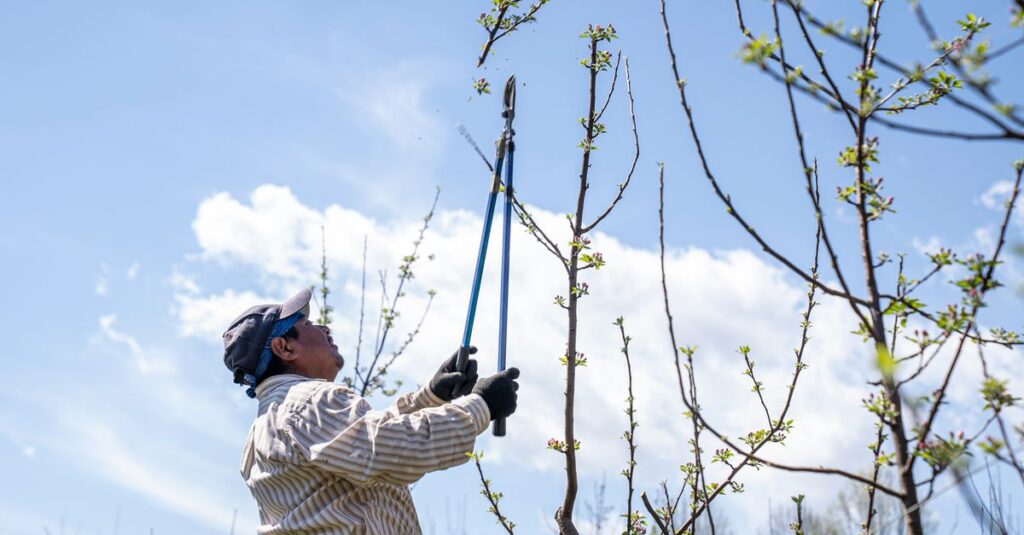
Photo by Mark Stebnicki on Pexels
Even well-chosen wind resistant trees can fail if they grow up with a weak structure. Washington State University Extension’s pruning chapter in the PNW Gardener’s Handbook says structural pruning aims to build a form that resists wind and the extra weight of ice or snow.
Its biggest warning is about codominant stems, where two branches of nearly equal diameter compete to be the leader. Because their wood tissue doesn’t overlap properly, the attachment is weaker and more likely to fail. The fix is cheap if you act early: remove one leader, or shorten it with a reduction cut, while the tree is young, and you end up with a small wound instead of a failed tree.
The same chapter says that trees receiving structural pruning in their first 15 to 25 years have longer lifespans, and that this training happens gradually over those years, not in one season.
Topping goes the wrong way. WSU calls it inappropriate: the stubs are prone to decay, and topped deciduous trees respond with weakly attached water sprouts that are more likely to fail in wind, ice or snow. Over-thinning large trees also raises their risk of failure in windstorms, and a lopsided canopy copes worse with storms and heavy snow.
If you’d like a trained eye on a young tree’s structure, our tree pruning service covers exactly this kind of early shaping.
What to do about a tree you already have
Most yards already have trees, and the question is whether one is a problem. Look for the warning signs the WSU chapter describes: two competing leaders, a lopsided canopy, old topping stubs and a crown thinned heavily to the ends of its branches.
Any one of those is worth a closer look from a qualified arborist. Our arborist services are available across Portland and within 25 miles, and we’re licensed in Oregon (CCB #206934).
When a tree has already failed or is leaning over a structure, call for emergency tree service. And when an assessment shows a tree can’t be kept safely, tree removal is the straightforward answer, with dead tree removal for the ones that have already died.
Before the next storm season, walk the property and check each large tree against the four traits that define wind resistant trees. Write down the ones that worry you and get them looked at while the weather is calm.
Frequently asked questions
Are evergreens better than deciduous wind resistant trees?
Colorado State University Extension calls conifers an excellent choice because their needles and flexibility handle high winds well. Deciduous trees with large, flat leaves tend to lose branches in strong gusts or under heavy wet snow.
Does topping make a tree safer in storms?
No. Washington State University Extension says topping isn’t an appropriate pruning strategy, because the stubs decay and the regrowth is weakly attached.
Can pruning make an existing tree more wind resistant?
On young trees, yes. Removing or shortening one of two competing leaders while the tree is small prevents a weak union that could split later, according to the same WSU chapter.
Is any tree completely wind proof?
None of the sources we’ve cited promises that. Species, structure, placement and care all play a part, so judge each tree individually and have a professional look at anything that worries you.
Sources
- Wind tolerant plants — University of Washington Botanic Gardens Elisabeth C. Miller Library
- Native trees thrive in waterwise Oregon landscapes — Oregon State University Extension
- Plant selection for windbreaks in Central Oregon — Oregon State University Extension
- Chapter 23: Pruning Woody Landscape Plants — Washington State University Extension