

Most of a tree’s roots sit in the top 18 inches of soil, which surprises almost everyone who asks how deep do tree roots grow. Oregon State University Extension puts it that plainly, and the other half of the picture is width: the root system reaches well past the branches.
That changes how you should think about a new patio, a utility trench or a tree that leans after a storm. The roots you can’t see are shallow, wide and easy to damage.
How deep do tree roots grow in a typical yard?
In most yards, the answer is not very deep. Oregon State’s guide for construction sites says most of a tree’s roots are within the top 18 inches of soil, and Colorado State University Extension estimates that in good soil about 90 to 95 percent of roots are in the top 36 inches.
Half of the fine roots that absorb water and nutrients are in the top 12 inches, according to the same Colorado State garden notes on root and soil disorders. Those are estimates, and Colorado State says they’re modified by actual soil conditions.
A tall tree doesn’t need deep roots to stay up. Its roots form a wide, flat plate that anchors it, which is why a big fir can look enormous above ground and still have most of its roots within a couple of feet of the surface.
Why roots stay shallow
Roots grow where there is air. Colorado State explains that a typical tree root system is shallow and wide-spreading because roots only grow where the soil holds enough oxygen.
Deeper soil is often dense, waterlogged or short on oxygen, so roots simply don’t go there in any quantity. Soil texture, moisture and paving matter more than the species label on the tree, according to Ashley Lloyd’s spring 2026 piece in Pacific Horticulture.
Compaction makes it worse. In compacted or clayey soil, Colorado State’s table puts 90 to 95 percent of roots in the top 12 inches or less, and half of the absorbing roots in the top 4 inches. A yard that’s been driven over, built on or walked across for years is that kind of soil.
How far do tree roots spread sideways?
Much farther than most people expect. Lloyd writes that functional roots often extend two to three times beyond the canopy drip line, with the fine feeding roots frequently reaching the farthest.
Colorado State gives a rule of thumb that depends on the soil. The table below sets out its estimates for how deep roots go and how far they travel.
| Soil condition | Roots in the top layer | Typical spread |
|---|---|---|
| Good soil, loose and well aerated | 90 to 95% in the top 36 inches | 2 to 3 times the tree’s height or canopy spread |
| Compacted or clayey soil | 90 to 95% in the top 12 inches or less | 5 or more times the height or canopy spread |
The pattern is easy to remember. When the ground is hard, roots stay shallow and run sideways looking for the room they can’t find below.
Do trees have a deep taproot?
Usually not for long, so how deep do tree roots grow is rarely a question about one central root. Young trees may start with a taproot, but Lloyd notes that this vertical root typically loses importance as lateral roots grow and take over.
The picture in many people’s heads, a root system that mirrors the canopy in a deep, symmetrical shape, is the main thing she sets out to correct. Roots follow the soil, not the shape of the branches.
The critical root zone: the area you shouldn’t disturb
Arborists use a measurement called the critical root zone to decide how much ground around a trunk needs protecting. The International Society of Arboriculture defines it, as Oregon State quotes, as a radius of one foot from the trunk for each inch of trunk diameter.
So a 6-inch tree has a 6-foot radius, and a 20-inch tree has a 20-foot radius, which is a circle roughly 42 feet across. Oregon State also notes that most of the mass of a tree’s root system sits inside that zone.
The branch edge, the dripline, is another common shortcut. Oregon State recommends checking both and using whichever gives the larger area, because the dripline alone tends to understate the roots at risk.
If you’d rather not measure at all, our tree protection page explains how we approach safeguarding trees on a property.
Digging, trenching and paving near a tree
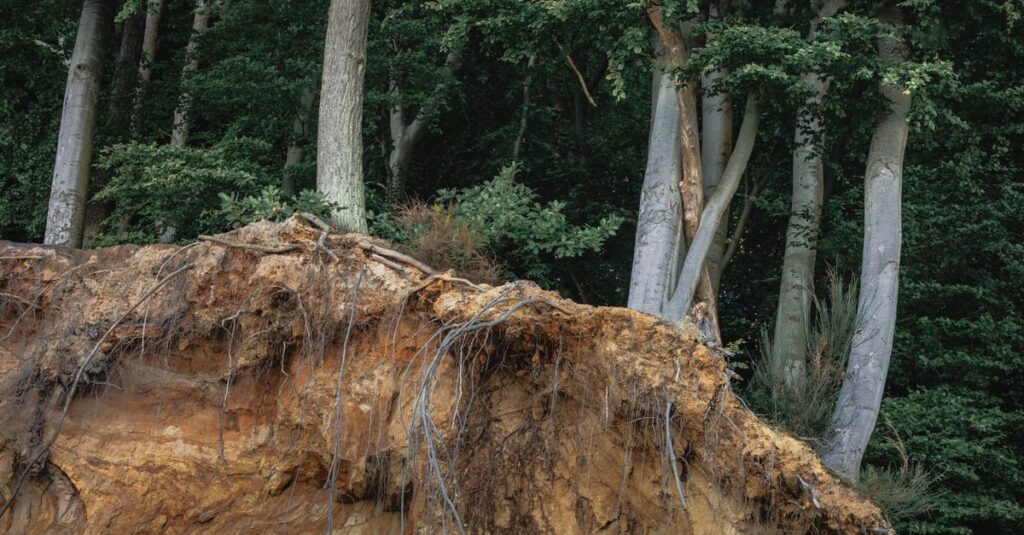
Photo by Serhii Barkanov on Pexels
This is where shallow roots cost homeowners money. A trench for a sprinkler line, a French drain or a new sewer connection cuts right through the layer where most roots live.
Oregon State’s advice is blunt: avoid trenching through the critical root zone entirely. When a utility line has to cross it, the guide says to tunnel or bore at least 18 inches beneath.
Size matters too. Roots thicker than 4 inches in diameter are likely structural, and Oregon State says to avoid cutting them, since doing so can threaten the stability of the tree.
Compaction does quieter harm. Parking a truck under a tree, stacking materials or running a skid steer across the roots squeezes the air out of the soil. Oregon State says never to compact the soil inside the critical root zone, and Colorado State warns there’s no quick, easy fix once it has happened.
Mulch is the gentle alternative. Colorado State suggests three to four inches of organic mulch such as medium wood chips, because less gives no protection and more reduces oxygen in the soil.
Why shallow roots matter for wind and storms
Once you know how deep tree roots grow, it’s clear why trees fall. A wide, shallow root plate holds a tree up well until something cuts into it or the soil turns soft. Construction damage, root cuts and saturated ground are the usual reasons a healthy-looking tree goes over in a storm.
If you’re choosing what to plant, our guide to wind-resistant trees for the Pacific Northwest covers which species hold up in local conditions. For one that’s already leaning or lifting soil at its base, we offer emergency tree service across the Portland area.
Signs of root trouble above ground include thinning leaves, dieback and fungus at the base. Our page on diagnosing plant problems explains what each one can mean.
When roots are a reason to call an arborist
Dig first and ask later is a poor order for any project near a large tree. Before a patio, driveway, addition or trench goes in, have someone look at where the roots are likely to be.
Monkeyman’s lists an ISA Master Arborist among its credentials, and our arborist services include evaluations that tell you whether a tree can survive the work planned around it. If the answer is no, tree removal is the safer choice than letting a weakened tree stand over the house.
Once a tree is down, the roots are still there. Stump grinding deals with the stump and the woody mass just under it.
Frequently asked questions
How deep do tree roots grow if they don’t go straight down?
Rarely deep. Most roots grow outward in the upper layers of soil, where oxygen and water are easiest to find, and any taproot a young tree starts with usually loses importance over time.
Will compacted soil make roots deeper or shallower?
Shallower. Colorado State’s estimates put nearly all roots in the top 12 inches of compacted or clayey soil, and the roots spread farther sideways to compensate.
How far from the trunk is safe to dig?
Stay outside the critical root zone when you can, which is one foot of radius per inch of trunk diameter. Where you can’t, Oregon State advises tunneling at least 18 inches beneath it instead of trenching across.
Can I cut a root that’s in my way?
Avoid cutting roots over 4 inches in diameter, since they’re likely structural. Have an arborist look at anything larger before a saw gets near it.
How deep do tree roots grow on a bigger tree?
Not necessarily deeper. Depth follows soil texture, moisture and oxygen more than tree size or species, so a tall tree in compacted soil can be shallowly rooted.
Sources
- Protecting trees on construction and development sites — Oregon State University Extension
- Diagnosing root and soil disorders on landscape trees — Colorado State University Extension
- As above, not so below — Pacific Horticulture
Cover photo by Masood Aslami on Pexels