

A large tree, generally one over 60 feet tall or with a trunk 20 inches or more in diameter, requires specialized rigging, climbing or crane equipment, and often a City of Portland permit before it can come down. These trees carry more weight, fall in a wider radius, and sit closer to homes, power lines, and neighboring property than smaller trees, which is why removal typically takes a trained crew rather than a single technician with a chainsaw.
This guide walks through what actually qualifies as a large tree, how professionals remove one safely, what Portland’s permit rules require, and how to decide whether a tree needs to come down at all. For a full price breakdown by tree height, see our tree removal cost guide; this article focuses on the process and decisions specific to large trees.
What Qualifies as a Large Tree?
There is no single legal definition of “large tree” that applies everywhere, since the term is used differently by arborists, insurers, and city code. In practice, size gets judged by a combination of height, trunk diameter, canopy spread, and species.
| Tree Size | Approx. Height | Typical Removal Complexity |
| Small | Under 30 feet | Low |
| Medium | 30 to 60 feet | Moderate |
| Large | 60 to 80 feet | High |
| Very large | 80 feet or more | Very high |
The City of Portland uses a different, code-specific measure: trunk diameter at breast height (DBH), measured 4.5 feet above the ground. Under Portland’s Tree Code, private-property trees 12 inches DBH or larger are classified as medium trees, and trees 20 inches DBH or larger are classified as large trees, which carry stronger preservation rules. A 20-inch DBH tree is roughly the size of an extra-large pizza box, too wide for most adults to hug alone.
How Much Does Large Tree Removal Cost in Portland?
Large tree removal (60 to 80 feet) in the Portland area typically runs $700 to $1,100, and very large trees over 80 feet can run $1,100 to $2,000 or more, depending on accessibility, proximity to structures, and tree condition. These figures reflect general Portland market pricing; an accurate number always requires an on-site inspection, since factors like a tight backyard, overhead power lines, or a multi-trunk structure can shift the price significantly in either direction.
| Factor | Why It Can Increase Cost |
| 60 to 80+ foot height | More climbing, rigging, and crew hours |
| Large trunk diameter | More cuts and heavier sections to control |
| Near a house or garage | Requires controlled, piece-by-piece lowering |
| Near power lines | Added safety coordination, sometimes utility involvement |
| Limited access | May require a crane or hand-carried debris removal |
| Dead or storm-damaged | Greater unpredictability, added safety precautions |
| Stump grinding | Priced separately from the removal itself |
| Full debris haul-away | Priced separately, based on volume |
Why Large Trees Are More Difficult to Remove Than Small Ones
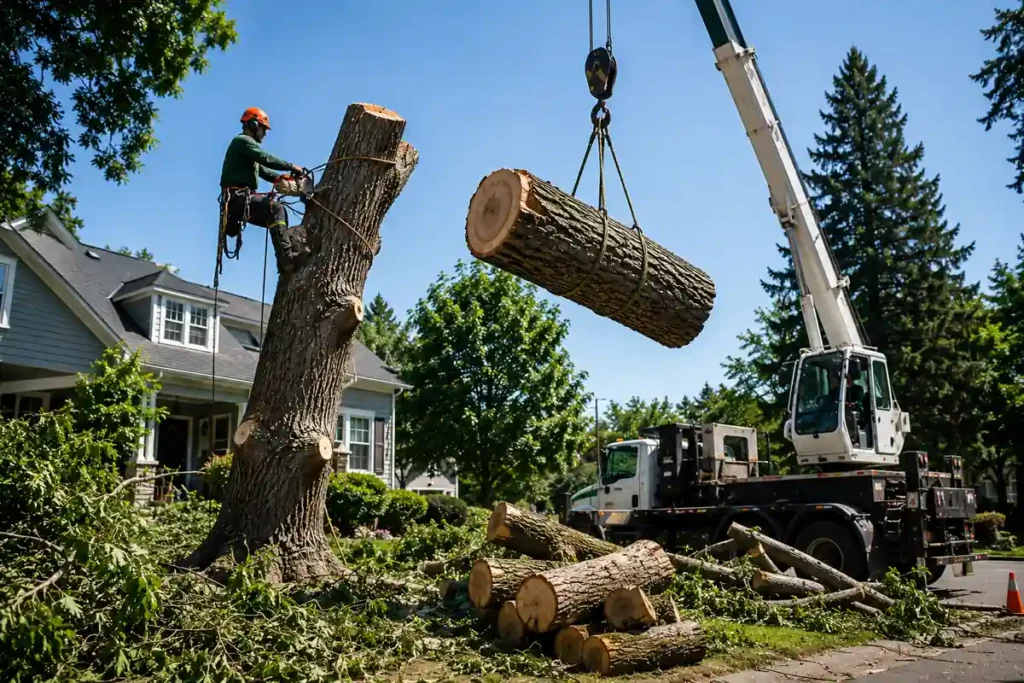
Size changes the physics of the job, not just the price. A large tree carries more total weight, has a longer fall radius, and often has internal decay or structural stress that isn’t visible from the ground. Where a small ornamental can sometimes be dropped in one piece into open space, a large tree near a home has to be dismantled from the top down, with each section lowered on a rope rather than allowed to fall freely.
That difference shows up directly in labor and equipment. Large removals typically require more rigging points, a bigger crew, chippers or a crane for hauling sectioned wood, and more time spent planning the drop zone before the first cut is made. It’s also why large tree removal, and tree felling specifically, ranks among the most hazardous tasks in landscaping and forestry work, a point covered in more detail below.
How Professionals Safely Remove a Large Tree
A large tree removal follows a structured sequence rather than a single cut. Here’s how a professional crew typically approaches it:
- Tree inspection. An arborist assesses species, height, trunk diameter, lean angle, overall health, and any visible structural defects like cracks or cavities.
- Site assessment. The crew identifies everything nearby that needs protection, including the house, garage, fences, vehicles, power lines, and landscaping, along with the best equipment access points.
- Removal method planning. Depending on size and access, the job may call for climbing and rigging, a bucket truck, ground-based cutting, or a crane for the most constrained sites.
- Rigging and drop planning. Rather than felling the whole trunk at once, crews plan how each major limb and trunk section will be controlled and lowered.
- Branch removal. Large limbs are cut and lowered in a controlled sequence, starting from the top of the canopy down.
- Trunk removal. The trunk is dismantled in sections sized to the site’s clearance, rather than dropped whole.
- Debris processing. Wood is chipped, cut into rounds, or set aside for firewood depending on what the homeowner wants to keep.
- Stump treatment. Stump grinding is typically a separate add-on service performed after the tree is fully down.
Does a Large Tree Need to Be Removed, or Can It Be Saved?
Not every large tree that looks concerning actually needs to come down. A tree with dead branches, some canopy thinning, or minor lean can sometimes be corrected with pruning, cabling or bracing, or targeted disease treatment rather than full removal. An ISA Certified Arborist can assess structural risk and recommend whether preservation is realistic before removal becomes the default answer.
Removal generally becomes the right call when a tree shows one or more of the following:
- Large dead branches throughout the canopy
- Major trunk cracks or visible cavities
- Significant fungal decay (heart rot or root rot are both common in Portland’s wet climate)
- Severe or worsening lean
- Root damage from construction, flooding, or soil disturbance
- More than half the canopy lost to storm damage
- Branches directly threatening a structure or power line
Because structural risk in a large tree is often invisible from the ground, homeowners generally shouldn’t attempt to diagnose these conditions on their own. A professional inspection is the safer starting point.
Large Tree Removal Near a House, Garage, or Power Lines
Proximity to structures changes the removal method, not just the price. A tree overhanging a roof or garage has to be dismantled in controlled sections, since dropping any part of it freely risks structural damage. Crews typically protect roofing, siding, and landscaping before work begins and plan each cut around a specific, cleared landing zone.
Trees near power lines require additional coordination and should never be handled as a DIY project. In many cases, the utility company needs to be notified or involved before work starts, particularly if a line will need to be de-energized. Trees near a road or shared property line add public safety considerations, including possible traffic control, that a licensed crew is equipped to manage.
Do You Need a Permit to Remove a Large Tree in Portland?
Yes, in most cases. Portland’s Tree Code (Title 11) regulates removal of medium trees (12 inches DBH or larger) and large trees (20 inches DBH or larger) on private property through two permit types:
- Type A permits are approved “by right” when a tree meets specific criteria, including being dead, dying, or hazardous; located within 10 feet of a building; listed as a nuisance species; or one of up to four healthy, non-nuisance trees under 20 inches DBH removed per year.
- Type B permits require additional city review and a site inspection. They apply when removing more than four healthy trees 12 inches DBH or larger in a year, or any healthy tree 20 inches DBH or larger. About 73 percent of Type B applications are approved.
Trees 36 inches DBH or larger removed from private property carry an additional requirement: a neighborhood notice must be posted on-site and shared with the surrounding neighborhood association before removal, using the City’s official notice template.
As of July 2025, the City eliminated nearly all tree permit fees, including removal and replanting permits, though the application and review process still applies. Small trees under 12 inches DBH generally don’t require a permit outside of environmental overlay zones. Because these rules can change and vary by exact site conditions, always confirm current requirements through Portland’s Urban Forestry program or our Portland tree removal permit resource page, which lists the right contact for every city and county in the metro area.
Worth noting: Portland is currently running a multi-year review of the Tree Code (through the 2026 to 2027 Title 11 update project) aimed at simplifying these rules, but no new code has been adopted yet. The permit structure described above reflects the code currently in effect.
Can You Remove a Large Tree Yourself?
Technically, some tree work is legal for a property owner to perform, but large tree removal carries a level of risk that ordinary yard work doesn’t. OSHA has called logging one of the most dangerous occupations in the country, and Penn State researchers who reviewed a decade of OSHA fatality data found that tree felling specifically, in both forestry and residential landscaping settings, was the single most dangerous task within two of the most hazardous industries in the United States. Being struck by falling wood was the leading cause of death in that research.
The risks compound with size: falling limbs, unpredictable trunk movement, chainsaw kickback, electrical contact near lines, and no clear escape route if a section doesn’t fall where expected. Homeowners insurance frequently won’t cover property damage caused by an amateur removal attempt, and equipment rental alone doesn’t come close to replicating the training, rigging, and crew coordination a professional job requires.
What Equipment Is Used for Large Tree Removal?
Not every job uses every tool, but large removals commonly involve:
- Chainsaws sized to trunk diameter
- Climbing gear (harnesses, ropes, spikes)
- Rigging equipment for controlled lowering
- A bucket truck, where access allows
- Wood chippers for branch debris
- Winches for directional pulling
- A crane, for the most constrained or hazardous sites
- Personal protective equipment (helmets, chaps, eye and hearing protection)
- A stump grinder, if grinding is included
What Happens to the Tree After Removal?
Once the tree is down, cleanup typically includes chipping smaller branches on-site, cutting the trunk into manageable rounds, and hauling debris away. Many homeowners choose to keep some of the wood as firewood rather than paying for full haul-away, which can reduce the total cost. Stump grinding is usually offered as a separate add-on, since not every homeowner wants the stump removed immediately, or at all.
How Long Does Large Tree Removal Take?
A straightforward large tree removal on an accessible lot typically takes a two- to three-person crew a few hours to complete, including initial cutting, chipping, and hauling. Trees near structures, power lines, or on difficult terrain, or jobs requiring crane support, can take a full day or longer once rigging, protective staging, and cleanup are factored in. An arborist can give a specific timeframe once they’ve seen the tree and site in person.
How to Prepare Your Property for Large Tree Removal
- Move vehicles and outdoor furniture away from the work area
- Keep children and pets indoors or off-site during the job
- Confirm equipment access, including gates and driveways
- Unlock any gates the crew will need
- Flag known underground utilities if you’re aware of any
- Decide in advance whether you want the wood hauled, chipped, or left as firewood
- Confirm whether stump grinding is part of the scope or a separate add-on
How to Choose a Large Tree Removal Company in Portland
Not every quote reflects the same training or insurance coverage, and a large tree is not the job to gamble on price alone. Before hiring, confirm:
- Licensing. Oregon tree service contractors should carry a valid CCB (Construction Contractors Board) license, verifiable through the state’s website.
- Insurance. Ask for proof of general liability and workers’ compensation coverage.
- Certification. Look for ISA Certified Arborists on staff, especially for trees near structures or power lines.
- A written, itemized estimate that separates removal, hauling, chipping, and stump grinding.
- Local permit knowledge, since a contractor familiar with Portland’s Tree Code can flag requirements before work starts.
Why Choose Monkeyman’s Tree Service for Large Tree Removal?
Monkeyman’s Tree Service has removed trees of every size across the Portland metro area since 2008, including leaning, storm-damaged, dead, diseased, and emergency removals handled through our tree removal services. Every crew includes ISA Certified Arborists, and every job starts with a free on-site estimate so pricing reflects your specific tree and property, not a generic average.
Frequently Asked Questions
What is considered a large tree for removal?
Most arborists consider a tree 60 feet or taller, or with a trunk 20 inches or more in diameter, to be large. Portland’s Tree Code specifically classifies private-property trees 20 inches DBH or larger as large trees, subject to stronger preservation and permit rules.
How much does it cost to remove a large tree in Portland, Oregon?
Large tree removal (60 to 80 feet) typically costs $700 to $1,100, while very large trees over 80 feet can run $1,100 to $2,000 or more, depending on accessibility, condition, and proximity to structures.
How long does it take to remove a large tree?
A straightforward job usually takes a few hours for a two- to three-person crew. Trees near structures, power lines, or requiring a crane can take a full day or more.
Do I need a permit to remove a large tree in Portland?
In most cases, yes. Trees 20 inches DBH or larger on private property generally require a Type B permit with city review, and trees 36 inches DBH or larger also require posted neighborhood notice before removal.
Can a large tree be removed without a crane?
Often, yes. Climbing and rigging handle most large removals. A crane typically comes into play only when access is severely limited or the site is too hazardous for standard rigging.
Can a large tree near a house be safely removed?
Yes, with the right process. Crews dismantle the tree in controlled sections rather than dropping it whole, protecting the roof, siding, and landscaping throughout.
Is it cheaper to trim a large tree or remove it?
Trimming is almost always cheaper than full removal, since it addresses safety or aesthetic issues without taking the tree down. Whether trimming is a viable option depends on the tree’s health and structural condition, which an arborist can assess.
Can I remove a large tree myself?
It’s legal in many cases, but OSHA and Penn State research both identify tree felling as one of the most dangerous manual tasks performed in the United States. Large trees, trees near structures, and trees near power lines should always go to a licensed, insured crew.
Does large tree removal include stump grinding?
Not usually. Stump grinding is typically quoted and performed as a separate add-on service after the tree is down.
What happens to the wood after a large tree is removed?
Branches are usually chipped on-site, and the trunk is cut into rounds. Many homeowners keep some wood as firewood, which can reduce the overall cost compared to full debris haul-away.
Have a large tree that may need to come down? Contact Monkeyman’s Tree Service for an on-site assessment and free estimate, or call (503) 358-8754.
Pricing reflects general Portland market data; get an on-site inspection for an exact quote. Permit information reflects Portland’s Tree Code as currently in effect; confirm current requirements with Portland’s Urban Forestry program before scheduling work, since code details can change.