
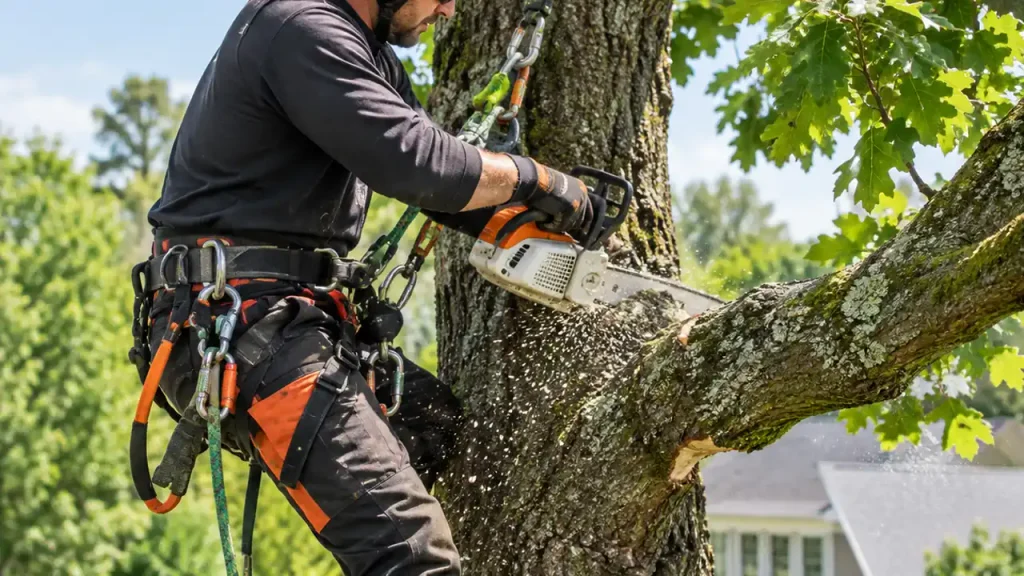
A tree surgeon is a trained tree care professional who prunes, repairs, braces, and removes trees using climbing, rigging, and specialized equipment, while protecting the health of the trees that stay and the safety of the property around them. In the United States the same role usually goes by “arborist” or “tree service professional,” but the job is the same: skilled, high-risk work on living trees.
If you are searching for a tree surgeon in the Portland metro area, you most likely have a specific tree in mind: one that is leaning, dropping limbs, hanging over your roof, or simply too big for its space. This guide explains what a tree surgeon does, how that differs from an arborist, what the work involves, what drives the cost, and how to choose someone qualified.
Monkeyman’s Tree Service has provided tree surgery, pruning, and removal across the Portland metro since 2008, with ISA Certified Arborists on staff and Oregon CCB license #206934.
What does a tree surgeon do?
A tree surgeon carries out physical work on trees, usually at height. The core tasks are:
- Pruning and crown work: removing dead, diseased, crossing, or weak branches, reducing crown size, and raising low limbs for clearance.
- Tree removal: felling trees in open space, or dismantling them piece by piece where there is no room to drop them whole.
- Cabling and bracing: installing support hardware in trees with weak unions or split stems that are worth keeping.
- Storm damage repair: removing broken, hanging, or split limbs and making clean cuts the tree can seal over.
- Stump grinding: grinding the remaining stump below grade after removal so it does not re-sprout.
- Hazard reduction: targeted work on trees near roofs, driveways, play areas, and power lines.
The difference between a tree surgeon and someone with a chainsaw is judgment. Every cut changes how a tree grows, how it carries weight, and how it resists decay. A qualified tree surgeon knows where to cut, how much to remove, and when a tree should not be cut at all.
Is a tree surgeon the same as an arborist?
The two roles overlap heavily, but they are not always the same person.
| Tree surgeon | Arborist (ISA Certified) | |
| Main focus | Hands-on work: climbing, pruning, rigging, removal | Tree health, risk assessment, and care planning, often plus hands-on work |
| Where the term is used | Common in the UK, Ireland, and Australia; used informally in the US | Standard US industry term |
| Credential | No single US credential for the title itself | Certification through the International Society of Arboriculture |
| Typical output | Completed tree work | Diagnosis, written reports, recommendations, and completed work |
The best outcome comes from a company that has both: certified arborists who assess the tree and decide what should happen, and skilled climbers who carry out the work. That is how Monkeyman’s is set up. Its ISA Certified consulting arborists bring over 50 years of combined experience, and its crews perform the pruning and removals they specify.
When do you need a tree surgeon?
Call a tree surgeon when a tree problem involves height, weight, or risk. Common situations:
| Situation | Likely work |
| Branches touching the roof or gutters | Crown reduction or selective pruning |
| Dead limbs over a driveway, patio, or walkway | Deadwooding |
| Tree leaning more than it used to | Hazard assessment, possibly removal |
| Split trunk or cracked main union | Cabling and bracing, or removal |
| Limbs hanging after a windstorm | Emergency storm response |
| Tree too close to the house or foundation | Assessment, reduction, or removal |
| Stump left from an earlier removal | Stump grinding |
| Lower limbs blocking a view, path, or street | Crown raising |
Some warning signs call for faster action. Mushrooms or shelf fungus at the trunk base, soil lifting or cracking around the roots, and a new lean after a storm can all point to root or trunk failure. Keep people and vehicles out from under the tree and have it assessed.
For urgent situations, Monkeyman’s runs 24-hour emergency tree service across the Portland metro.
What does tree surgery involve, step by step?
A professional tree surgery job follows a clear sequence.
- Assessment. An arborist inspects the tree’s structure, health, lean, root zone, and surroundings, and identifies what could be hit if something falls.
- Work plan. The crew chooses the method (climbing, bucket truck, crane, or a combination) and decides where branches and wood will be lowered.
- Permit check. Many Portland-area removals and some pruning jobs are regulated, so the company confirms what is required before work starts.
- Site protection. Drop zones are set up, and structures, lawns, and landscaping are protected.
- Climbing and rigging. Climbers secure themselves and set rigging points so heavy sections can be lowered under control rather than dropped.
- Cutting. Pruning cuts are made at the branch collar so the tree can seal the wound. Removals are taken down in sections where space is tight.
- Clean-up. Branches are chipped, wood is cut or hauled, and the stump is ground if that is part of the job.
Controlled rigging is what separates tree surgery from simple felling. On a typical Portland lot, with houses, fences, and power lines close by, most large trees have to come down in pieces.
What methods do tree surgeons use?
Pruning to ANSI A300
Professional pruning in the US follows ANSI A300, the national standard for tree care operations. It sets out how and where to cut, how much live canopy to remove, and which practices to avoid. Monkeyman’s performs all tree trimming and pruning to ANSI A300.
Crown reduction instead of topping
Topping cuts large branches back to stubs. It looks like quick size control, but it produces weakly attached regrowth and large wounds prone to decay, which makes the tree more hazardous over time. Crown reduction shortens branches back to a healthy side branch, keeping the tree’s natural shape and structure. A qualified tree surgeon will recommend reduction and will not top a tree.
Sectional removal
When a tree cannot be felled in one piece, it is dismantled from the top down. Limbs and trunk sections are cut and lowered on ropes, or lifted out by crane on larger jobs. This is the most skilled and most dangerous part of tree surgery.
Cabling and bracing
Steel cables and rods can support a mature tree with a weak branch union or a split stem. This is often the best way to keep a valuable tree standing safely instead of removing it.
Stump grinding
After removal, the stump is ground below the soil surface. Grinding is the only reliable way to stop many species from sending up new shoots. Monkeyman’s uses equipment matched to the job, from compact grinders for tight backyard access to one of the largest stump grinders on the market for oversized conifer stumps.
How much does a tree surgeon cost in Portland?
There is no fixed price for tree surgery, because cost depends on risk and access far more than on tree size alone. Monkeyman’s gives a free, custom estimate for every job, along with a written receipt and a safety guarantee.
These factors drive the price:
| Factor | Keeps cost lower | Pushes cost higher |
| Tree size | Small, under about 30 feet | Mature fir, cedar, or oak with a large trunk |
| Access | Open yard with truck access | Fenced backyard, slope, or no equipment access |
| What’s underneath | Open lawn | Roof, fence, garden, vehicles, or power lines |
| Method | Straight felling | Climbing and sectional rigging, or crane work |
| Tree condition | Healthy, sound wood | Dead, decayed, or storm-damaged wood |
| Clean-up scope | You keep the wood and chips | Full haul-away of logs and brush |
| Stump | Left in place | Ground below grade |
| Timing | Scheduled weekday work | After-hours emergency response |
Dead and damaged trees often cost more than healthy trees of the same size. Decayed wood behaves unpredictably under the saw and on the ropes, so the work is slower and needs more rigging.
Do you need a permit for tree surgery in Portland?
Often, yes, especially for removals. The City of Portland regulates many tree removals on private property, and the rules depend on tree size, species, and location. Portland’s tree code is administered by Portland Urban Forestry. Nearby cities such as Lake Oswego, Beaverton, and Tigard each have their own tree rules, so the same job can need a permit in one city and not in the next.
Monkeyman’s checks permit requirements before work begins and handles the application process on the customer’s behalf.
Can a tree surgeon save a tree instead of removing it?
Often, yes. Removal is not always the answer. A good tree surgeon looks at the options first:
- Selective pruning to remove the dead or defective part of the canopy.
- Crown reduction to take weight off long, heavy limbs.
- Cabling and bracing to support weak unions.
- Plant health care to treat the soil, pest, or disease problems behind a tree’s decline.
Removal becomes the right choice when a tree has serious root decay, an unstable root plate, extensive trunk rot, or is dead and within striking distance of a building. A certified arborist assessment is how you tell the difference, and Monkeyman’s provides written arborist evaluations when a decision needs documenting.
Does emerald ash borer affect tree surgery in Portland?
Yes, for anyone who owns an ash tree. According to the Oregon Department of Agriculture, emerald ash borer was first confirmed in Forest Grove on June 30, 2022, the first detection of the beetle on the West Coast. As reported by Oregon Public Broadcasting in August 2026, it has since spread into Multnomah, Clackamas, Yamhill, and Marion counties, with the Oregon Department of Forestry newly confirming it in Beaverton, Salem, Silverton, and the Rock Creek area.
The beetle kills ash trees, and Oregon Department of Forestry foresters have warned that infested trees turn brittle as they die. Brittle wood is harder and more dangerous to climb, rig, and remove, so timing matters. Healthy, valuable ash trees may be candidates for treatment, while declining trees are usually safer to remove before they become brittle. If you have an ash on your property, have it assessed early.
How do you choose a qualified tree surgeon?
Ask these questions before anyone works on your trees:
- Do you have ISA Certified Arborists? Certification shows formal training and ongoing education. Monkeyman’s arborists are ISA Certified.
- Are you licensed and insured? In Oregon, check the contractor’s CCB license. Monkeyman’s is licensed under CCB #206934 and carries $1,000,000 liability insurance.
- Do you prune to ANSI A300? If the answer is vague, or they suggest topping, look elsewhere.
- How will you protect my property? Ask how branches and wood will be lowered and what equipment will be used.
- Will you handle the permit? A full-service company checks and files permits for you.
- Is the estimate free and in writing? Get the scope, method, clean-up, and price in writing.
- Are stump grinding and haul-away included? Confirm exactly what the price covers.
Be cautious of door-to-door offers after storms, very low cash quotes, and anyone who cannot show proof of insurance. Tree work is one of the most dangerous trades, and an uninsured crew can leave the property owner exposed if something goes wrong.
Why do Portland homeowners choose Monkeyman’s for tree surgery?
- Serving the Portland metro since 2008, family owned and operated.
- ISA Certified Arborists with over 50 years of combined consulting experience.
- ANSI A300 pruning on every job.
- Licensed, bonded, and insured: Oregon CCB #206934 and $1,000,000 liability coverage.
- Full service: tree removal, pruning, stump grinding, land clearing, plant health care, and 24-hour emergency response.
- Permits handled for customers.
- Free estimates anywhere within 25 miles of Portland.
Service areas include Lake Oswego, Beaverton, Clackamas, Oregon City, Aloha, Sherwood, Tigard, Tualatin, West Linn, Milwaukie, Gladstone, and Wilsonville.
Need a tree surgeon in Portland? Call Monkeyman’s Tree Service at (503) 358-8754 for a free estimate.
Frequently asked questions
What is the difference between a tree surgeon and a tree trimmer?
A tree trimmer typically handles lighter pruning and shaping, often from the ground or a ladder. A tree surgeon performs the full range of work at height, including climbing, rigging, large limb removal, sectional tree removal, and structural support. Tree surgery requires more training, more equipment, and more insurance.
Is it safe to do tree surgery yourself?
Light pruning of small branches you can reach from the ground is fine. Anything involving a chainsaw above ground level, limbs over a structure, trees near power lines, or trees taller than about 20 feet should be left to trained professionals with proper insurance and equipment.
How long does a tree surgery job take?
Pruning a single medium-sized tree may take a few hours, while a large sectional removal with stump grinding can take a full day or more. Access, tree size, what is underneath, and weather all affect timing, and your estimate should give an expected duration.
What time of year is best for tree surgery in Portland?
Late winter, while trees are dormant, is best for most pruning because the branch structure is easy to see and wounds close quickly in spring. Spring-flowering trees are best pruned right after they bloom. Dead, damaged, or dangerous limbs should be dealt with at any time of year.
Will tree surgery damage my lawn or garden?
A professional crew plans drop zones, lowers heavy sections on ropes, and uses equipment suited to the site to limit ground damage. Ask your tree surgeon how they will protect lawns, beds, and hardscape before work begins.
Do tree surgeons remove the stump?
Stump grinding is usually quoted as a separate item. Monkeyman’s can remove the tree, grind the stump, chip the branches, and haul the wood, or leave the wood for the property owner, depending on what you prefer.
Can a tree surgeon work near power lines?
Trees touching or very close to energized power lines must be handled in coordination with the utility, so contact the utility first. Only qualified line-clearance workers may work within the restricted distance of power lines.
How do I know if my tree needs surgery or removal?
Fungus at the base, cracks in the trunk, a new lean, heaving soil, or large dead sections all suggest a problem, but only an arborist inspection can tell whether pruning, bracing, treatment, or removal is right. Monkeyman’s offers free estimates and certified arborist assessments across the Portland metro.
Written with the ISA Certified Arborist team at Monkeyman’s Tree Service, serving the Portland metro area since 2008. Oregon CCB #206934. Licensed, bonded, and insured.