

Cut a branch in January and the tree has weeks of cold, slow weather to seal the wound before insects and fungi wake up. That timing is the biggest of the winter tree pruning benefits, and it’s why extension horticulturists keep pointing homeowners to the dormant season for most landscape trees.
Below, we cover what winter pruning gets you, which trees follow a different calendar, how much to remove, and when a ladder and a pruning saw are the wrong tools for the job.
The five winter tree pruning benefits worth knowing
Dormant trees are easier to read, less exposed to pests and quicker to recover from a cut. Each of those comes down to one fact: in winter the tree isn’t spending energy on leaves and new shoots.
You can actually see the tree
Without leaves, the full branch structure is visible. Illinois Extension notes that dormant pruning gives increased visibility of the tree’s shape, so crossing limbs, weak unions and dead wood stand out instead of hiding in foliage.
Fewer pests and diseases reach the cuts
Montana State University Extension says pruning in the dormant season reduces the risk of pest and disease problems affecting the cuts. Insects that find fresh wounds in warm weather simply aren’t flying in January.
Wounds have time to close
A correct cut at the branch collar lets the tree seal the wound and block decay. Late winter pruning leaves enough time for that closure before the growing season puts new demands on the tree.
You steer spring growth
Oregon State University Extension recommends pruning when the tree is dormant because it gives you the best chance to shape it for strong, healthy growth. That advice comes from an apple-tree guide, but the logic holds for most deciduous trees. Cut the framework now and the tree puts its spring energy into the branches you left.
You avoid the late-summer trap
Prune in late summer or fall and you trigger tender growth. Montana State warns that fall pruning encourages new growth that is susceptible to cold damage. Winter, with growth shut down, doesn’t carry that risk.
When is the best time to prune trees in winter?
For most deciduous trees, late winter just before spring is the sweet spot for pruning in winter. Oregon State’s guide calls it the best time because the worst cold has passed, which lowers the chance of frost damage to fresh cuts while the tree is still asleep.
The exact window depends on what you’re pruning. Here’s how the sources we trust break it down:
| Tree or plant | When to prune | Why |
|---|---|---|
| Hardwoods | Dormant season | OSU Extension’s EC 1576 says to prune hardwoods while dormant |
| Conifers | October to February | Pitch flow, which attracts harmful insects, is minimal; avoid spring and early summer |
| River birch | Late fall to early winter | Sap flow is reduced after leaf drop |
| Lilacs and other spring bloomers | Right after flowering | They flower on last year’s growth |
| Dead, dying or broken branches | Any time | Hazards don’t wait for a season |
The conifer row comes from Oregon State’s woodland pruning guide, which was written for forest fuel reduction but states the timing plainly. The river birch and lilac advice is from Illinois Extension and Montana State.
What about evergreens?
Evergreens follow a tighter script, and most of the winter tree pruning benefits above apply to them only in part. Illinois Extension says fall pruning isn’t recommended for evergreens, and it places juniper and yew in March or April, before new growth emerges.
Pine, spruce and fir generally need very little pruning, and the same source advises against removing their lower branches. Pines get pruned in spring or early summer, at the candle stage, by removing two thirds of the elongated bud. So if a neighbor tells you to cut everything in January, the advice fits your maple better than your spruce.
How much can you cut in one winter?
Keep it conservative, because the winter tree pruning benefits only show up when the tree keeps enough foliage to feed itself in spring. Montana State’s rule is to remove no more than one third of the branches at a time, and big corrections can be spread over several years.
Oregon State’s woodland guide allows up to half of the live crown, but it also says to leave at least a one-third live-crown ratio. For a backyard tree you want to keep healthy, the lower number is the safer limit.
Topping isn’t a shortcut. Montana State’s advice on that is two words: don’t.
Cut it right: collars, stubs and wound paint
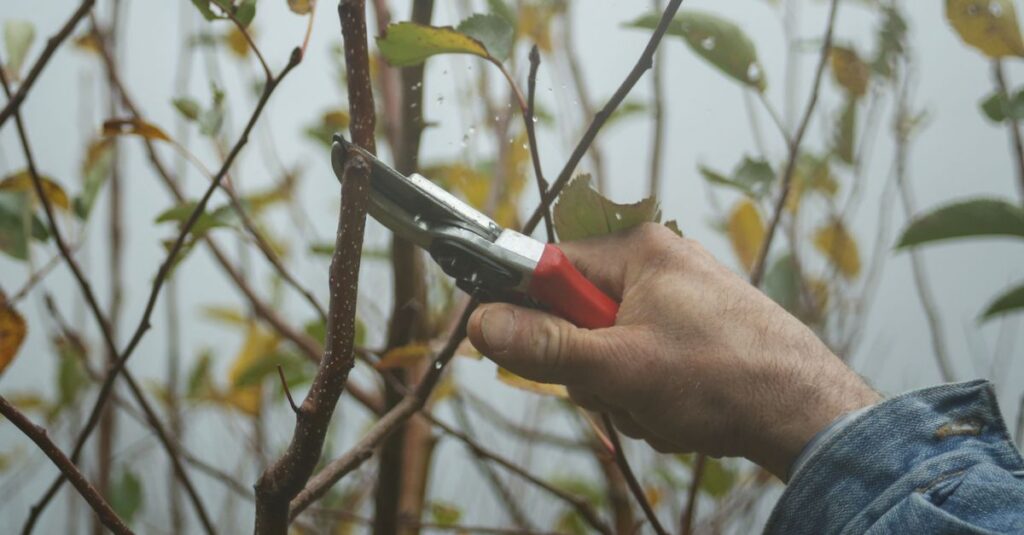
Photo by Maria Turkmani on Pexels
Make the cut at the branch collar, not flush with the trunk and not a few inches out. Oregon State says flush cuts and stubs both prolong healing.
Skip the wound dressing too. Montana State notes that paints and dressings can hinder a tree’s natural healing and can act as a refuge for pests and diseases.
Clean tools matter in a way people forget. Illinois Extension recommends sanitizing with a 10% bleach solution or undiluted 70% isopropyl alcohol, and between every cut if you suspect disease.
When a tree needs a professional, not a pruning saw
Montana State says branches over four inches should be handled only by someone with the right tools and experience, such as a certified arborist. Add anything overhead, anything near a roof or power line, and a tree you can’t reach from the ground, and the job belongs to a crew.
Our credentials include an ISA Master Arborist and Oregon license CCB #206934, and our tree pruning work covers everything from thinning a crown to taking off a hazardous limb. If you’re not sure what a tree needs, our arborist services start with an evaluation rather than a saw.
Planting or replacing trees too? Our guide to wind-resistant trees for the Pacific Northwest covers what holds up in Oregon storms, and winter pruning helps those trees keep their structure.
Winter tree pruning benefits start before the cold does
If you prune in late winter, you’re making cuts a few weeks before the tree wakes up. To be ready, do your assessment in fall, which our fall yard cleanup guide walks through.
Then choose who does the work. Our piece on how to hire a tree service company lists the questions to ask before anyone climbs a tree, and our tree care page shows the rest of what we handle through the year.
If a branch fails in a winter storm, that’s a different job, and our emergency tree services team handles it.
Frequently asked questions
Is it bad to prune trees in fall?
Usually, yes. Illinois Extension and Montana State both discourage late-summer and fall pruning because it encourages tender new growth that can be damaged by cold before it hardens off. That contrast is a large part of the winter tree pruning benefits: the cuts happen when the tree can’t respond with fresh, vulnerable shoots.
Can I remove dead branches at any time of year?
Yes. Montana State and Illinois Extension both say dead, dying, broken or diseased branches can be removed whenever you notice them, since they’re a hazard regardless of season.
Should I paint the cut ends after pruning?
No. Oregon State and Montana State both advise against wound dressings, which can slow healing and may seal in decay organisms.
Do spring-flowering shrubs get pruned in winter?
Not if you want blooms. Lilacs and similar shrubs flower on last year’s growth, so Montana State says to prune them right after they flower.
Sources
- Trim trees, shrubs in the dormant season for stronger, healthier plants — University of Illinois Extension
- Why, when, and what to prune — Montana State University Extension
- Reducing hazardous fuels on woodland property: Pruning (EC 1576) — Oregon State University Extension Service
- Prune apple trees in late winter for stronger growth and better fruit — Oregon State University Extension Service